The Well-Being Atlas
Readings in Well-Being
An evolving index of independent, reproducible data essays on how people rate their lives — each hand-built from survey microdata: the GSS, Gallup (US Daily and World Poll), and the World and European value surveys.
Topic
Scope & source
50 of 50
What Matters When
Run the same model of happiness at every age and a different predictor takes the lead each decade: relationships in youth, money in midlife, politics at the door of retirement, faith and health at the end — and self-rated health is the only force that leads at every age.
IncomeReligionAgeAt Home and Out of Place
The conservative–liberal happiness gap is a geography, not a constant. Republicans rate their lives the same wherever they live; Democrats slide downhill the redder the county — so the gap converges to zero in blue states and yawns widest in the reddest, most rural ones.
PoliticsGeographyWhat Faith Pays For in Secular Europe
Adjusted within country for age, income and gender, religious attendance in Europe tracks more meaning (+0.36 SD never→daily), a worthwhile life and a higher life-rating — but not a calmer or less-depressed week. Faith buys purpose, not mood.
IncomeGenderReligionCan Marriage and Church Explain It?
The conservative happiness advantage in the GSS is about 7 points. Adjust step by step for marriage, churchgoing, income and health and ~75% dissolves — religion does the most work, income almost none — but a stubborn quarter (1.8 points) survives every control.
IncomeReligionHealth & DespairThe Continent's Quiet Scissors
How Europeans rate their lives and how their week actually felt mostly agree (r=0.86) — but the calm-and-anxiety dimension pulls apart (r=0.50), and a few countries feel notably better or worse than their life-rating predicts.
Health & DespairThe World Is a Little Happier on the Right
Across the Values Surveys, people who place themselves on the political right report higher life satisfaction than those on the left in 89 of 99 countries — a near-universal gap of about half a point, holding rich and poor, free and unfree.
IncomeGeographyThree Ways to Rank a Continent
Rank Europe by how people rate their lives, by how their week felt, and by whether life feels worthwhile, and you draw three different maps. Meaning refuses to follow satisfaction — Kosovo is 21st of 29 on life-rating but first in Europe on meaning.
Health & DespairFifty Years of a Partisan Happiness Gap
In the General Social Survey, U.S. conservatives have reported being very happy more often than liberals in 31 of 33 years since 1974 — a ~7-point gap that runs through happiness and mental health, but not physical health.
PoliticsHealth & DespairThe Map of European Contentment
A 2017 map of European life satisfaction: a Nordic and Alpine peak (Switzerland 8.0, Norway 8.0, Finland 7.9) above a still-lagging East (Ukraine and Bulgaria 6.2) — and the same geography largely repeats for freedom and health.
Health & DespairGeographyThe Family Premium in Secular Europe
In secular, low-fertility Europe marriage still carries a clear life-satisfaction premium (married 7.25 vs widowed 6.31) — but having children does not: the satisfaction line stays flat from zero kids to four.
Health & DespairThe Autonomy Engine
The feeling of freedom and control over your own life is Europe's strongest correlate of life satisfaction — stronger than health — positive in almost every country, and it rose most in the post-communist East.
Health & DespairLeft, Right, and Content
Across Europe, the further right people place themselves, the more satisfied with life they report — a clean gradient from 6.85 (far left) to 7.42 (far right), and it survives adjustment for who sits where.
GeographyThe Post-Communist Mood
After 1989, life satisfaction across the former Eastern bloc collapsed to a 1999 trough (~5.7), then recovered and converged toward the West — the cross-country spread shrank as Romania (+1.6) and the Baltics climbed.
Health & DespairThe Changing Recipe of a Good Life
Run the same model of life satisfaction in poor and rich countries and the ingredients shift: financial satisfaction’s grip eases, the sense of freedom nearly doubles in weight (0.14→0.27), and the pull of relative income rank fades to zero.
IncomeThe Great Convergence
Since 1981 national life satisfaction grew more alike: the post-communist world climbed ~2 points out of its mid-1990s trough (Albania +2.4, Ukraine +2.2) while some wealthy nations slipped, and the cross-country spread fell 49%.
Health & DespairThe Freedom to Be Happy
Across 100+ countries and 40 years of the Values Surveys, the sense of freedom and control over one’s life predicts life satisfaction better than income or health — a within-country coefficient of 0.30, and r=0.77 across 107 national averages.
IncomeHealth & DespairFeeling Behind
Financial satisfaction tracks where Americans think they rank more than the dollars they actually have: the perceived-rank gradient spans a full point and saturates at the top, and adding rank to a model collapses the income effect by about 61%.
IncomeGeographyThe Satisfaction Treadmill
Real family incomes rose about a third from 1972 to 2022, but Americans' satisfaction with their finances never followed — the share 'pretty well satisfied' fell from 33% to 23%, and beneath the flat average the top and bottom thirds pulled apart from 0.43 to 0.62 points.
Health & DespairLosing My Religion
Americans leave the faith they were raised in at four times the rate they did fifty years ago — and what that costs in happiness depends less on where you started than on where you stand now.
ReligionGeographyThe Pew, Not the Prayer
Religion is good for happiness — but it's the showing up, not the believing, that does the work: attendance carries roughly twice the happiness of private prayer or belief, and survives when both are entered together.
Health & DespairSomeone to Count On
Having someone to count on is worth about 1.5 ladder points — one of the largest gaps in well-being — and a generous welfare state, far from substituting for it, makes that private safety net matter more, not less.
GeographyOut of Reach — When the American Dream Stopped Feeling Possible
The belief that the system gives you a fair shot has quietly collapsed — agreement fell from 78% in 2000 to 45% in 2024 — and that belief is worth real happiness.
Health & DespairOut of Place — The Geography of the LGBT Well-Being Gap
Daily distress runs high for LGBT Americans everywhere, but how poorly they rate their lives widens where the county climate turns hostile — and in those same places, fewer people say they are LGBT at all, so the widening gap is a lower bound.
GeographyLower on the Ladder, Lighter in the Day
Ask whether Black or white Americans are happier and the honest answer is: by which measure? They rate their current lives slightly lower, yet report calmer days — less worry and less stress — at every income level, and most among the affluent.
IncomeRaceHealth & DespairThe Optimism Gap
Americans disagree enormously about how much better their lives will get — and the least hopeful group is the white working class, not the poor of color.
IncomeRaceKeeping Up With the County
Take two Americans on the same paycheck and drop one in a richer county — the comparison drags down the middle, barely touches the rich, and slightly lifts the poor.
IncomeGeographyWhose America Is Thriving? Whoever Just Won
Across a decade of daily interviews, Americans rated their own lives higher when their party held the White House — and the partisan gap flipped sign at each handover. Both sides do it; it is the winning that moves the mood.
RacePoliticsDoes Generosity Pay — Everywhere?
Across 155 countries, people who give — money, time, or a hand to a stranger — rate their lives higher and feel better day to day; the link holds in rich countries and poor ones alike, and is strongest for giving money.
IncomeCommunity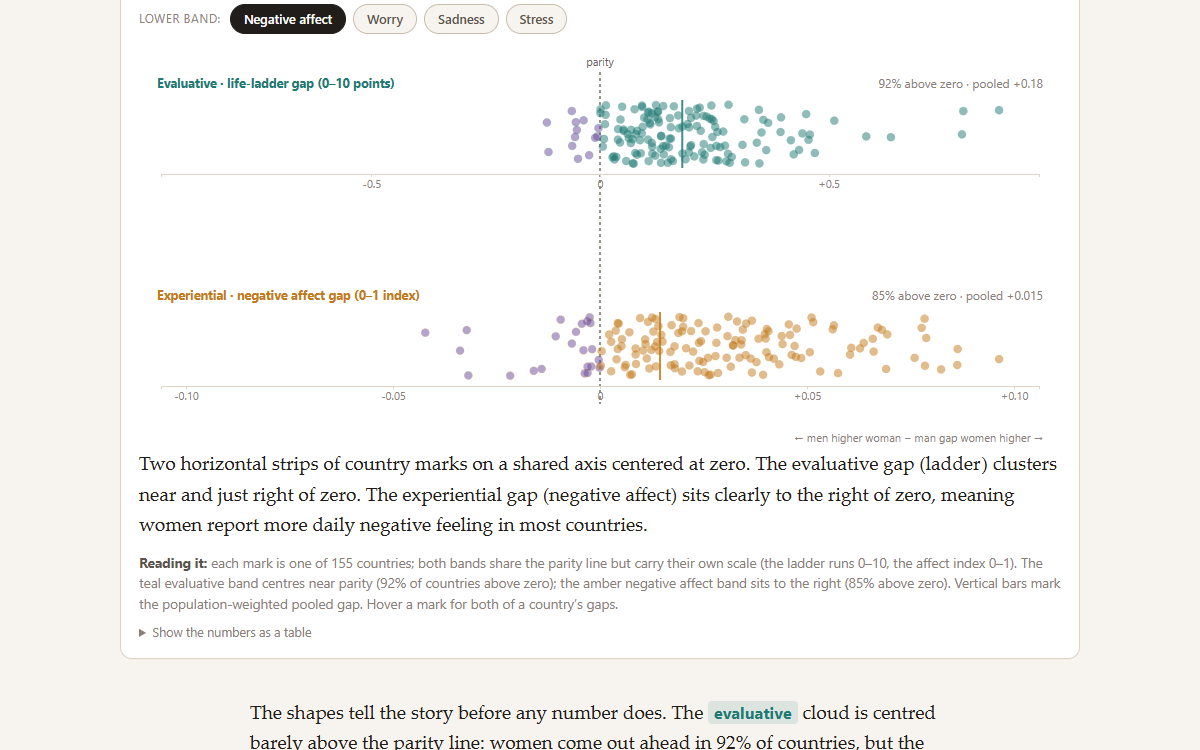
The Gender Well-Being Paradox, Measured Two Ways
Across 155 countries, women rate their lives at least as high as men in nine of ten places — yet report more daily worry, sadness, and stress. Two gender gaps that point opposite ways, each with its own inequality gradient.
GenderHealth & Despair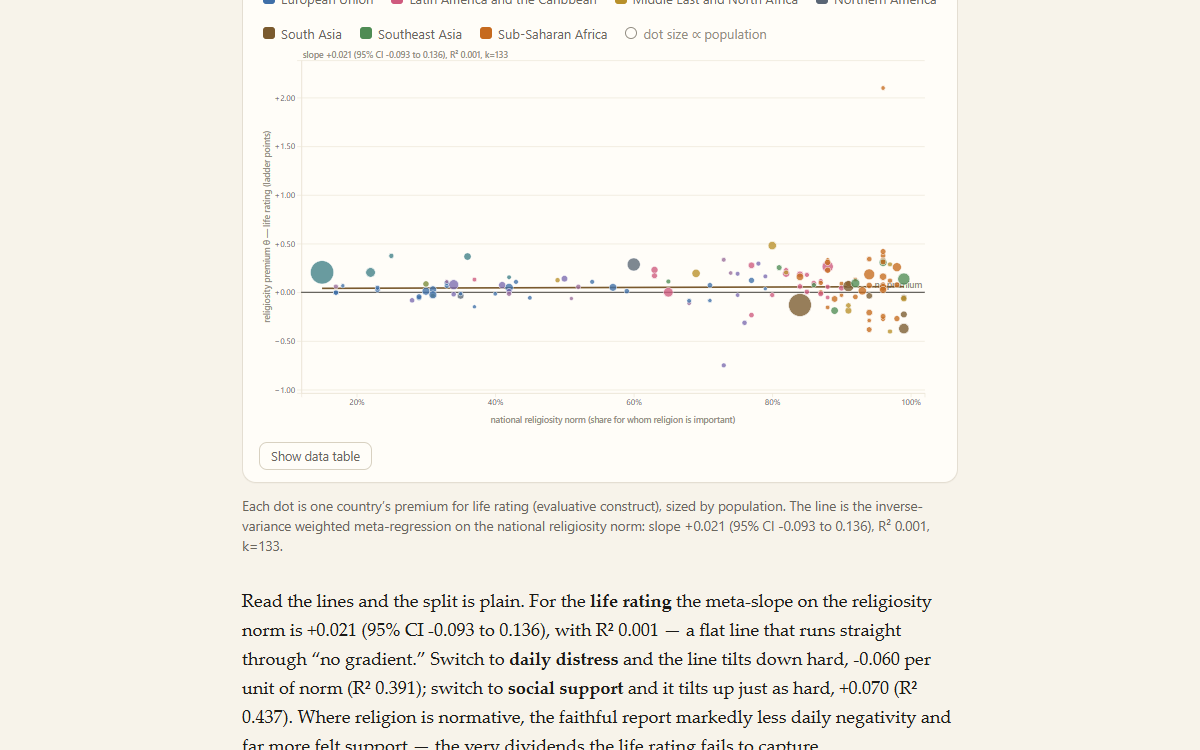
Faith Pays Off Where Faith Is the Norm
Across countries, being religious lifts your life rating only a little — and barely more in devout societies than secular ones. But the experiential dividend of faith, less daily distress and more felt support, swells sharply where religion is the social norm.
ReligionGeographyMoney Moves Your Life Rating More Than Your Mood
Inside almost every country, richer people both rate their lives higher and feel better day to day — but the life-rating slope is steeper than the mood slope in 96% of countries, and the gap widens with development.
IncomeDoes the Ring Still Matter?
For fifty years, married Americans have reported more happiness than everyone else — a gap that has barely budged, and that survives even after you account for who tends to marry.
Health & DespairReligion's Conditional Dividend
Across 143 countries, faith tracks higher life evaluation and better days — but mainly where life is hard. As nations grow richer and safer, the religious advantage bends toward zero.
ReligionGeographyThe Paradox That Didn't Hold
In the 1970s American women called themselves happier than men. A famous study watched that lead vanish — extend the data eighteen more years and the decline doesn't continue, it dissolves into noise.
Gender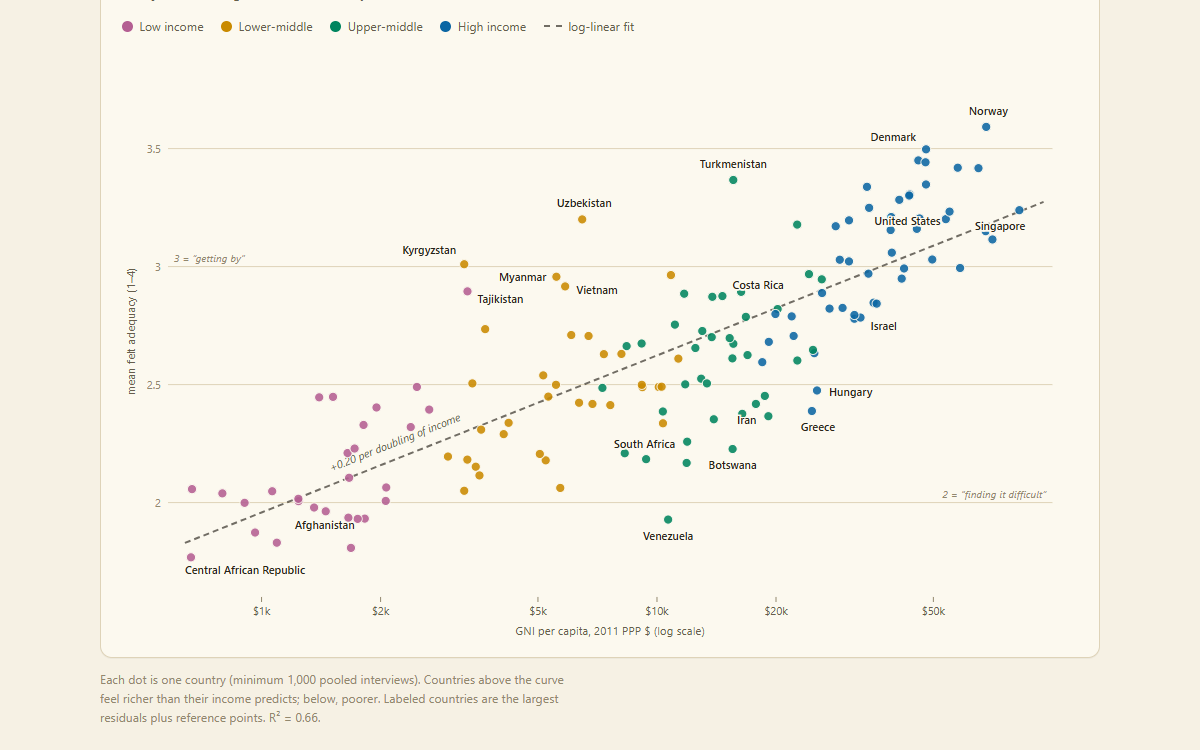
Feeling Rich Is Not the Same as Being Rich
Money buys the feeling of enough everywhere and never stops — but Central Asia feels richer than its GDP, southern Africa poorer, and the countries that rate their lives best are not the ones that feel paid.
Income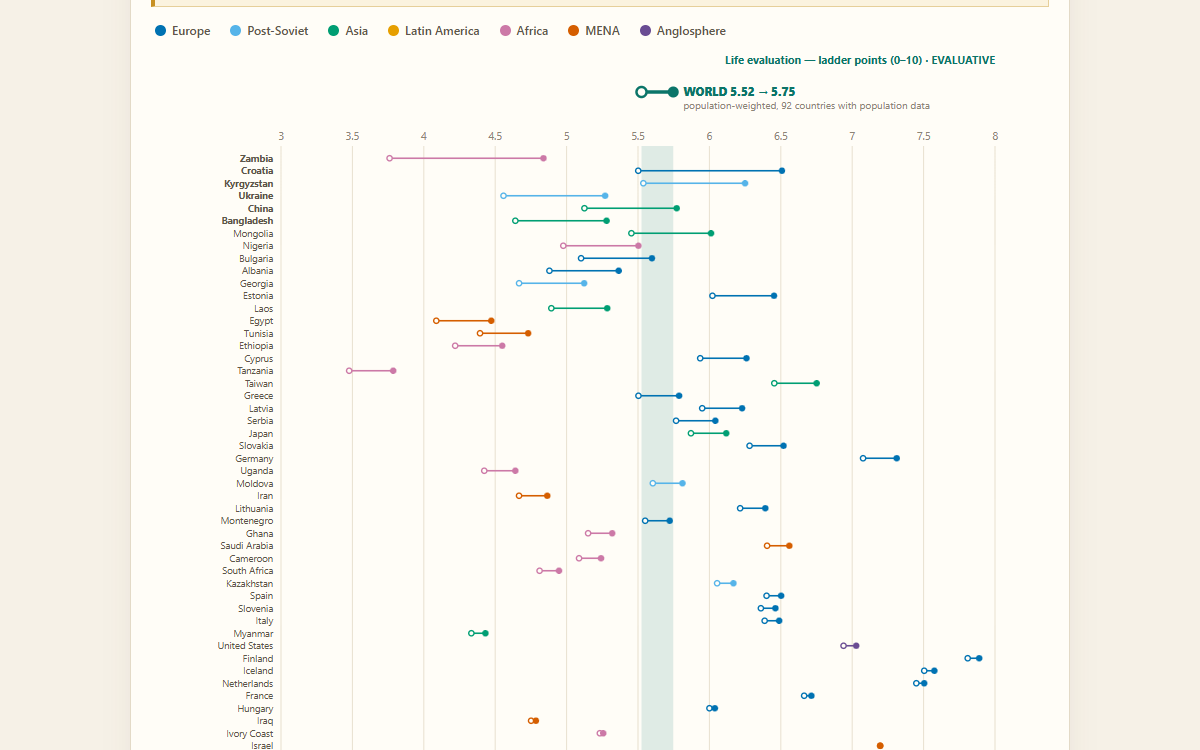
2020: The World’s Worst Year?
In 2020 daily worry, sadness and stress hit fifteen-year records across 93 countries — yet the world’s rating of its own life didn’t fall: +0.22 ladder points with China, +0.04 without.
Health & DespairFifty Years of American Evenings
Since 1974 the General Social Survey has asked the same four questions: how often do you spend an evening with relatives, with friends, with neighbors, at a bar? The company thinned. The glow stayed. And the people who still gather now look happier, relative to those who don’t, than they did when the asking began.
CommunityThe Flip Counties Felt It First
In the 223 counties that voted for Barack Obama in 2012 and Donald Trump in 2016, people rated their day-to-day lives almost exactly like residents of similar counties that never flipped. What sagged, years before any ballots were cast, was the future.
PoliticsGeographyDoes Community Substitute for Connection?
Fifty years of social-capital theory promised that civic-rich places would matter most for people with the thinnest personal ties — or, in the rival telling, least. In 921,639 Gallup interviews, the answer is sharper than either story: the gap barely moves at all.
IncomeCommunity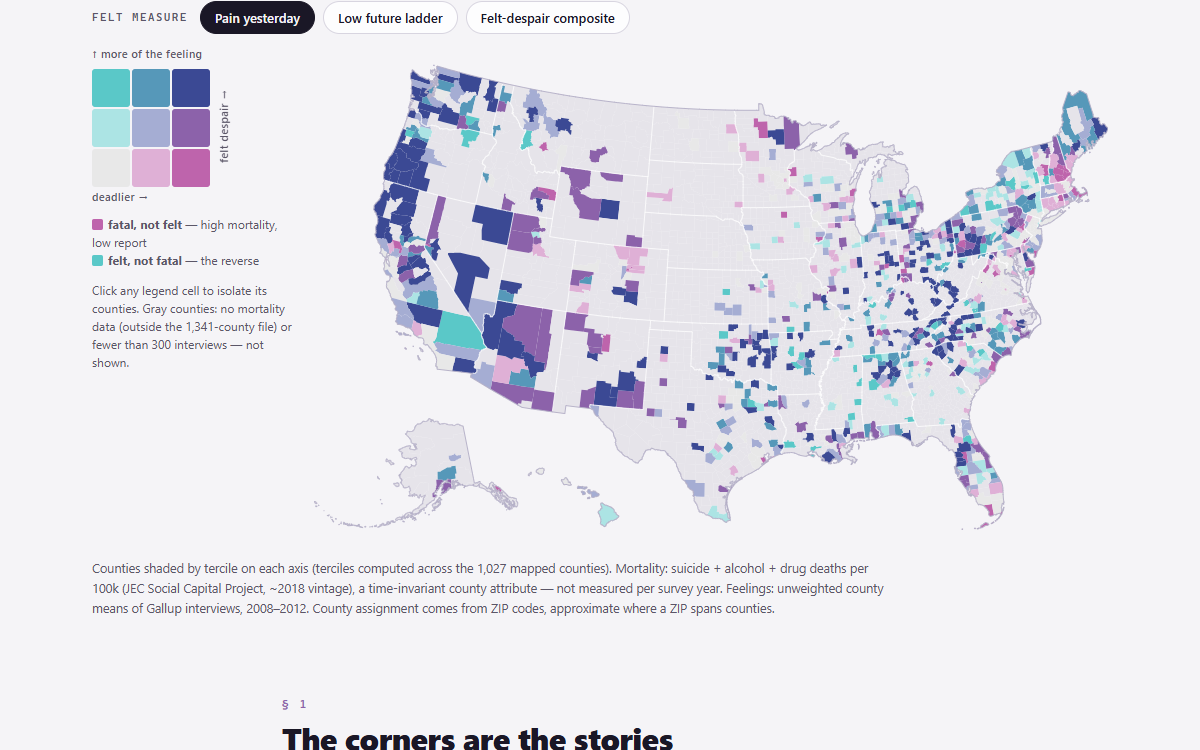
Despair, Felt and Fatal
Deaths of despair gave America a mortality map. Buried in 1,769,079 Gallup interviews is the question that map raises: which feeling lives in the places where people die? Not sadness. Not worry. Pain — and a future that looks shorter than the present.
Health & DespairGeography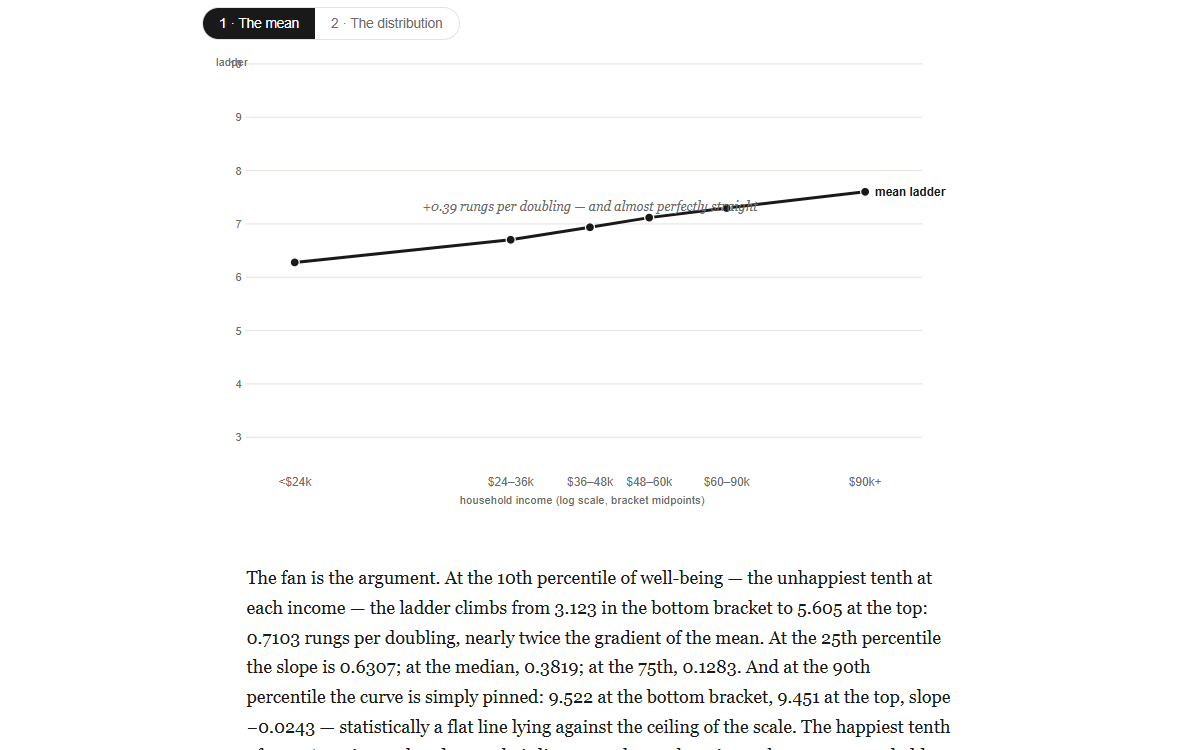
The Plateau Is in the Tail, Not the Mean
For more than a decade, social science fought over whether money stops buying happiness around $75,000. Re-run the question on 1.8 million Gallup interviews — the same survey the fight began on — and the answer is that everyone was staring at the wrong line.
Income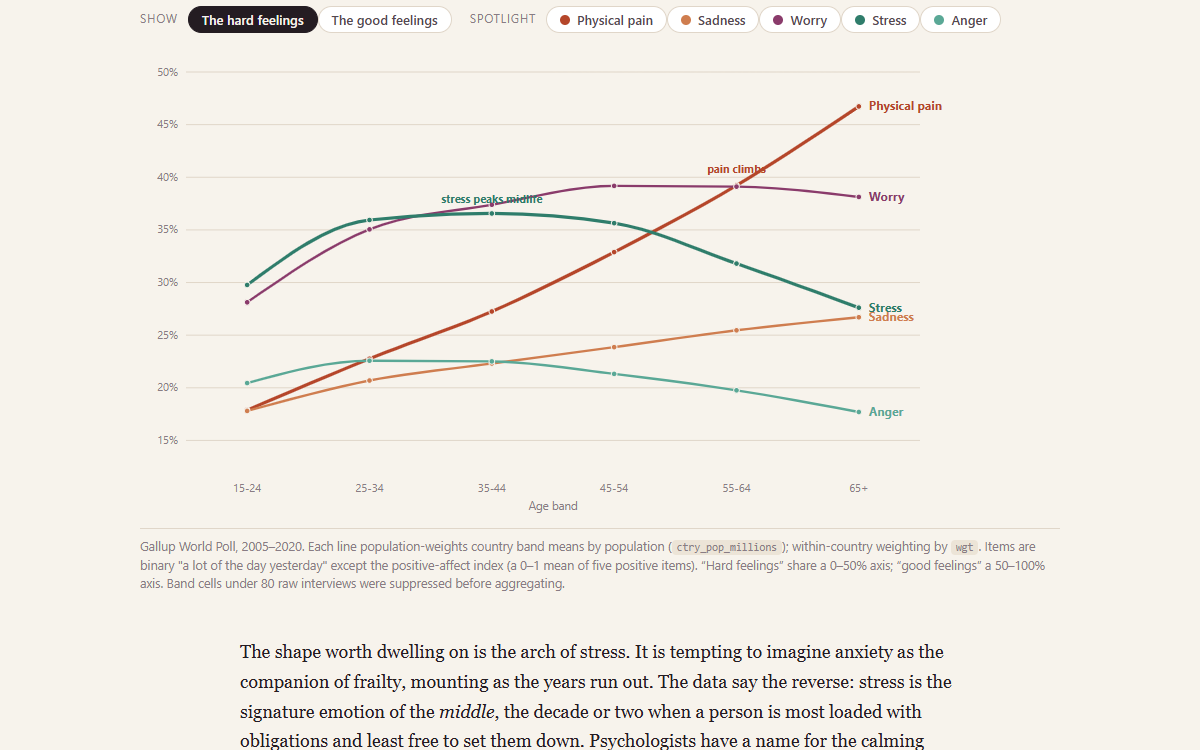
The Two Clocks of Growing Old
As people age worldwide, the mind's agitations fall — stress peaks in midlife and anger hits a lifetime low by 65+ — while pain (18%→47%), sadness and health limits climb. Whether old-age worry eases or deepens is sorted by money: 0.31 in rich countries vs 0.47 in poor.
IncomeAgeHealth & Despair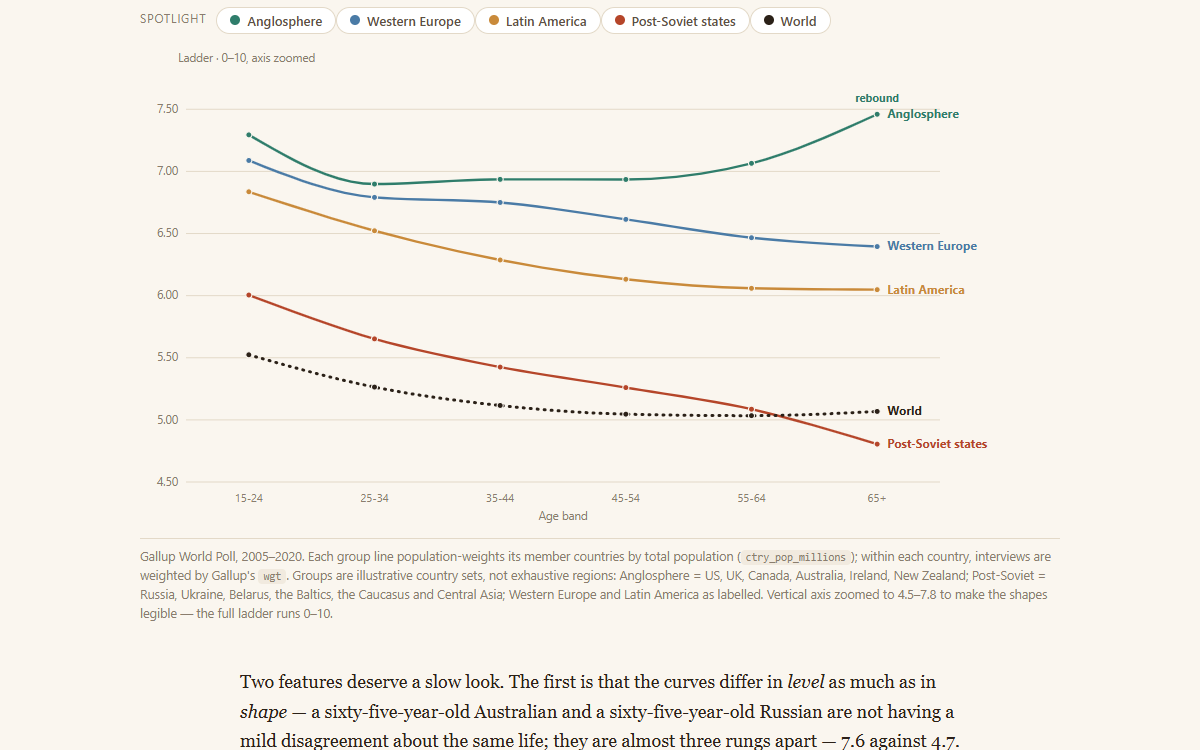
The U-Curve, Redrawn
The famous midlife dip and old-age rebound in happiness is real but local: vivid in the wealthy Anglosphere (+0.53 ladder points recovered), absent or inverted across the post-Soviet world (−0.28). Only 34 of 156 countries show a genuine U.
Age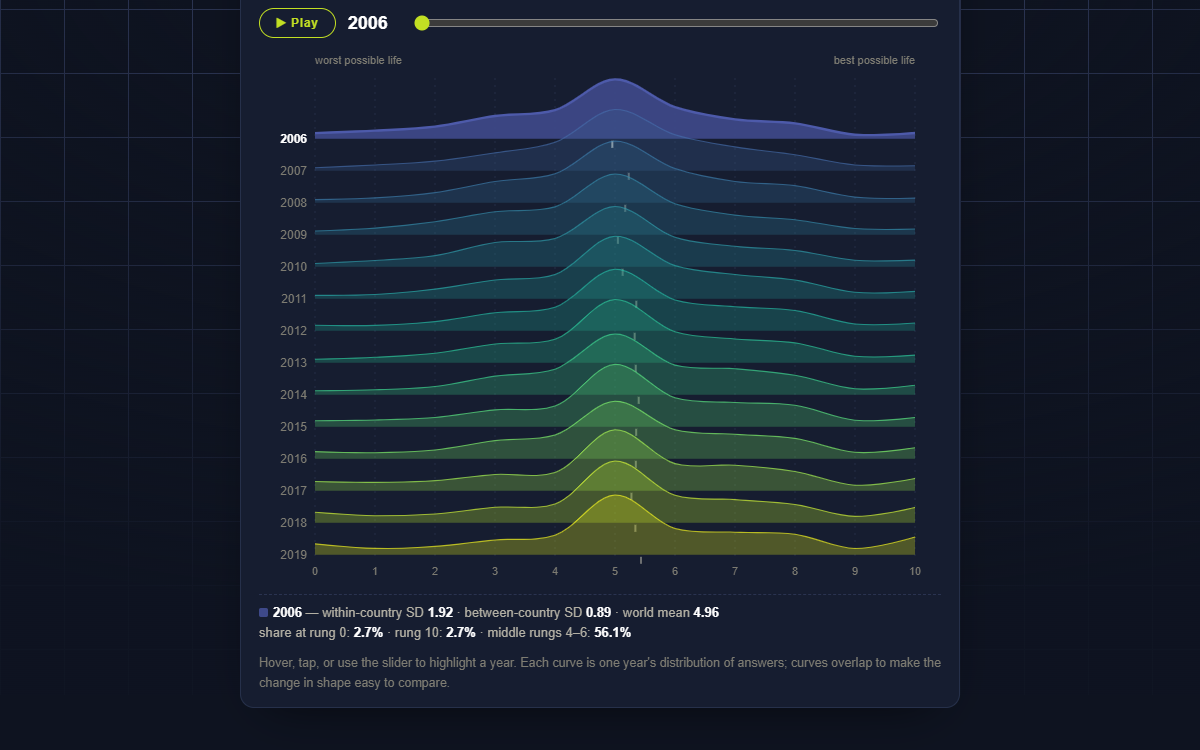
Happiness Moved Inside Borders
From 2006 to 2019 the world grew happier and nations grew more alike — but inside 39 of 42 countries, the distance between the happiest and unhappiest citizens widened.
Health & Despair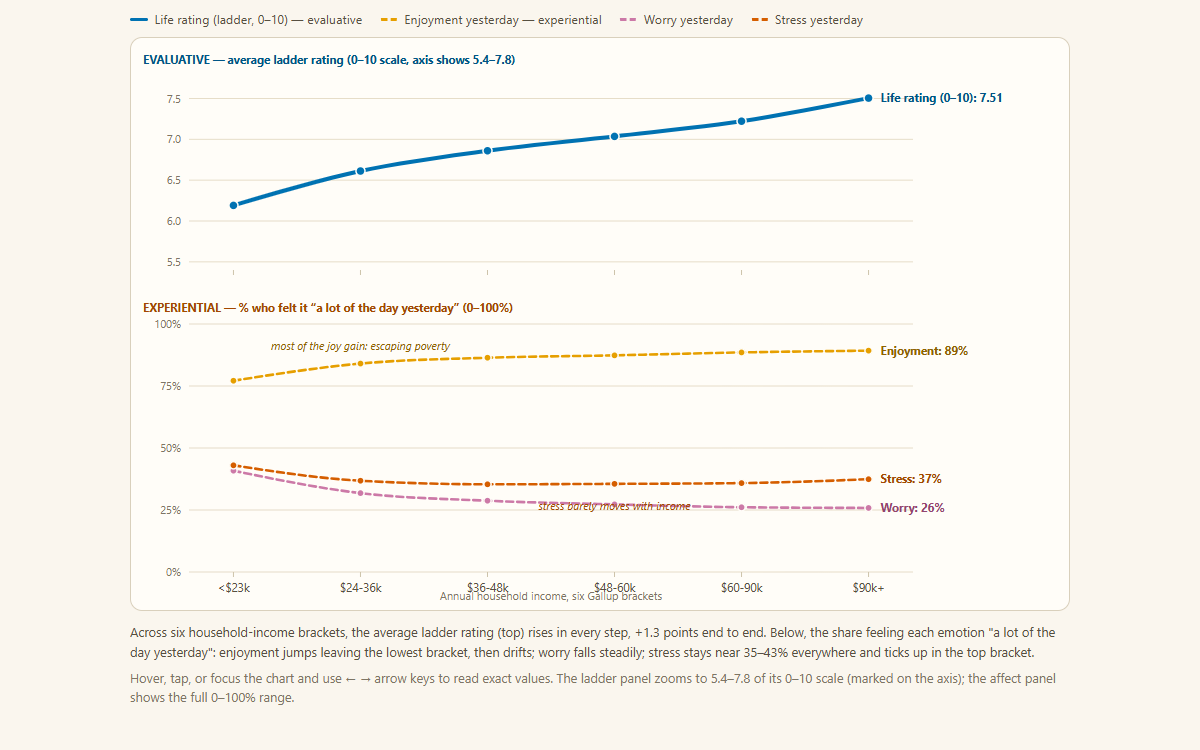
Money Buys Calm, Not Joy
Across the income ladder, how people rate their lives climbs steeply while daily enjoyment plateaus above poverty and stress barely moves — what money most clearly buys is freedom from worry.
IncomeHealth & Despair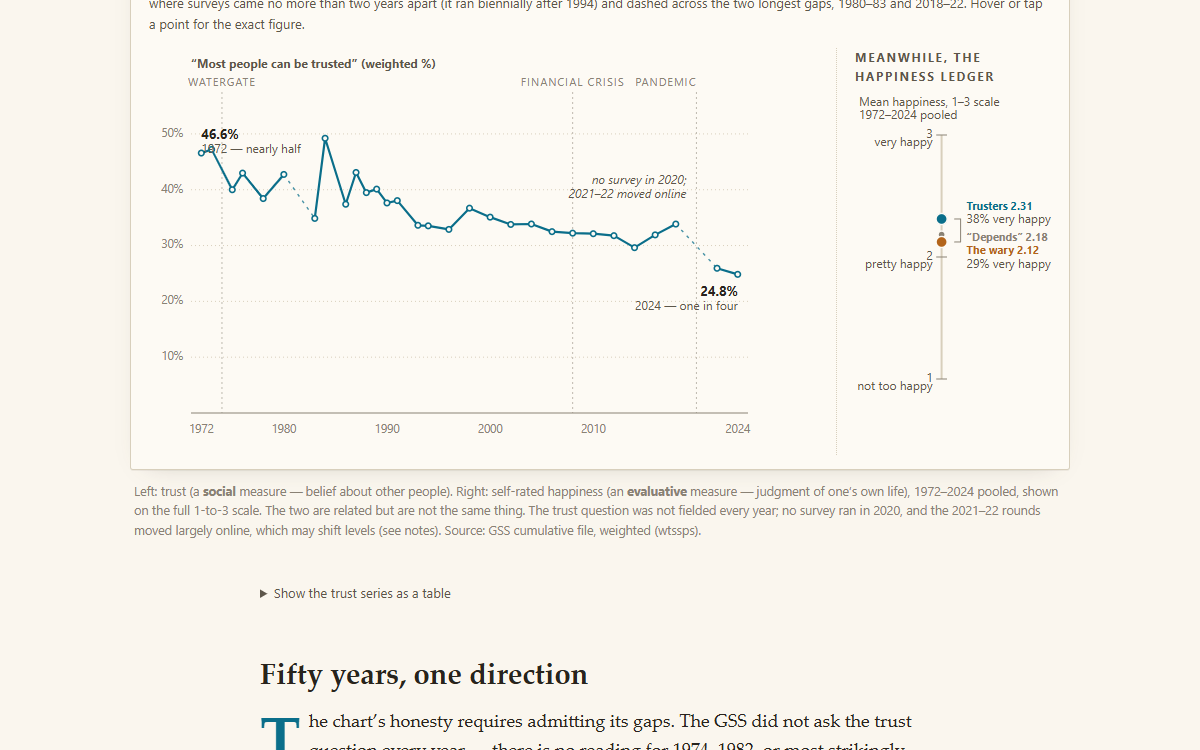
The Long Retreat of Trust
The share of Americans who say most people can be trusted has nearly halved since 1972 — 47% to 25% — while the durable happiness gap between trusters and the wary held firm.
Trust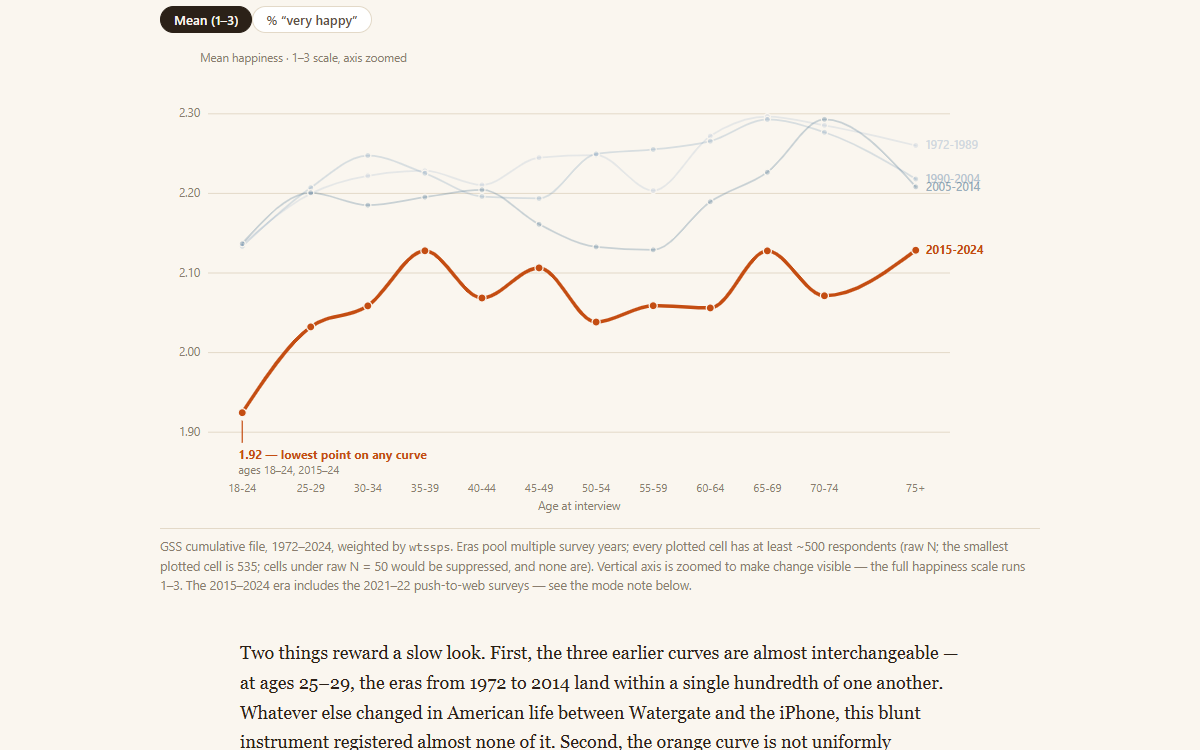
Young and Less Happy
In the GSS, happiness has always risen gently with age. Over the past decade the youngest adults fell to a 50-year low — 1.80 in 2021, 1.91 in 2024 — pulling away from everyone else.
Age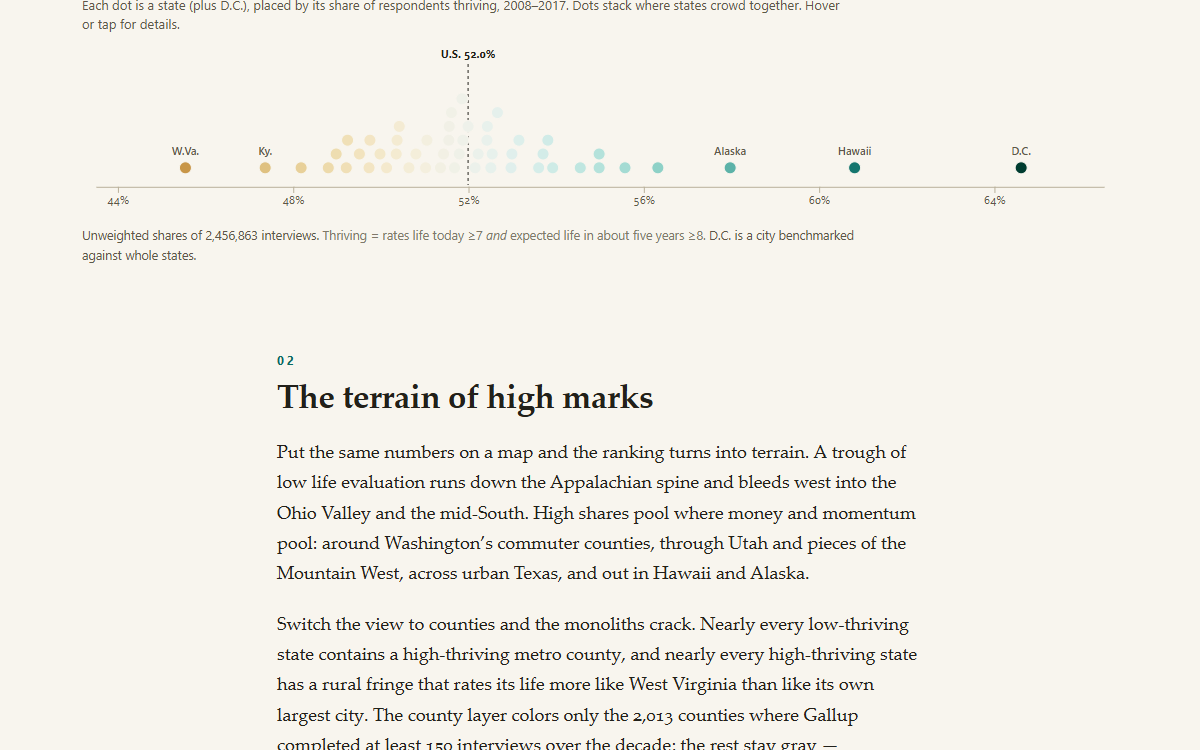
The Geography of American Thriving
Across 2.46 million interviews, the share of Americans 'thriving' in how they rate their lives spans about 19 points between states — and at the county level it tracks income, rurality, and deaths of despair.
IncomeHealth & DespairGeography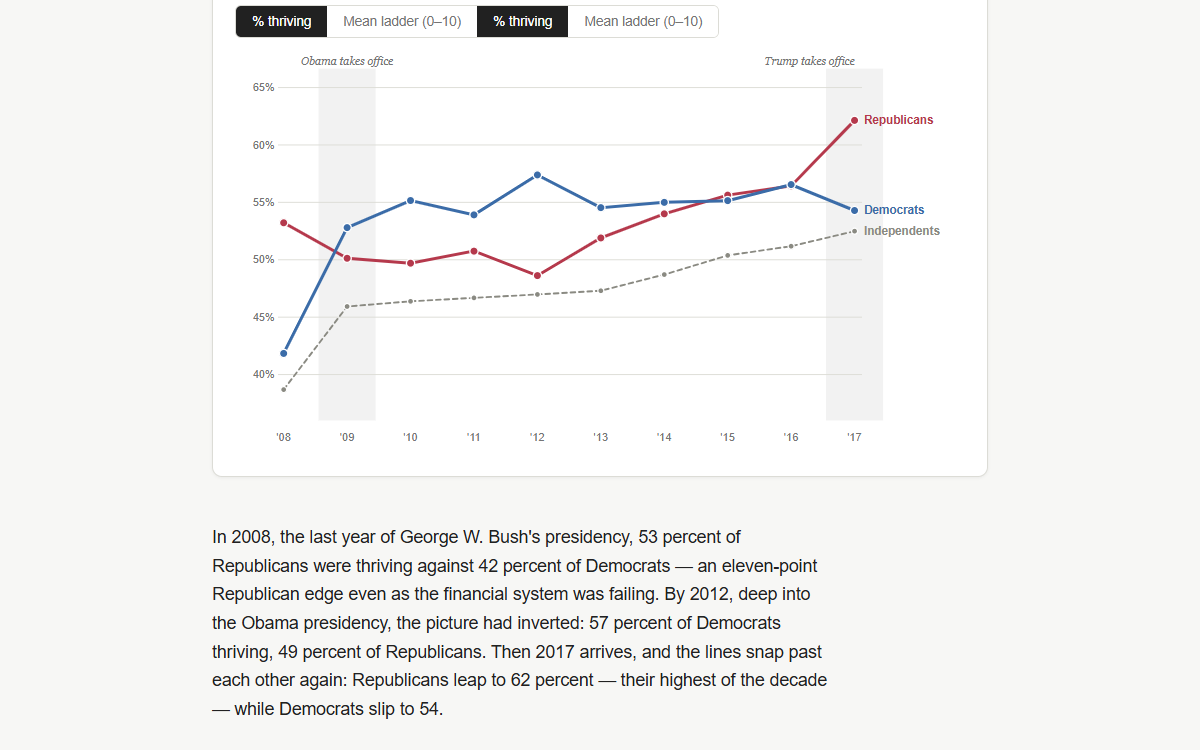
Whose America Is Thriving? Whoever Just Won.
Ten years and 3.5 million interviews show partisans' life evaluations crossing twice — once when Barack Obama took office, and again, in the opposite direction, when Donald Trump did.
Politics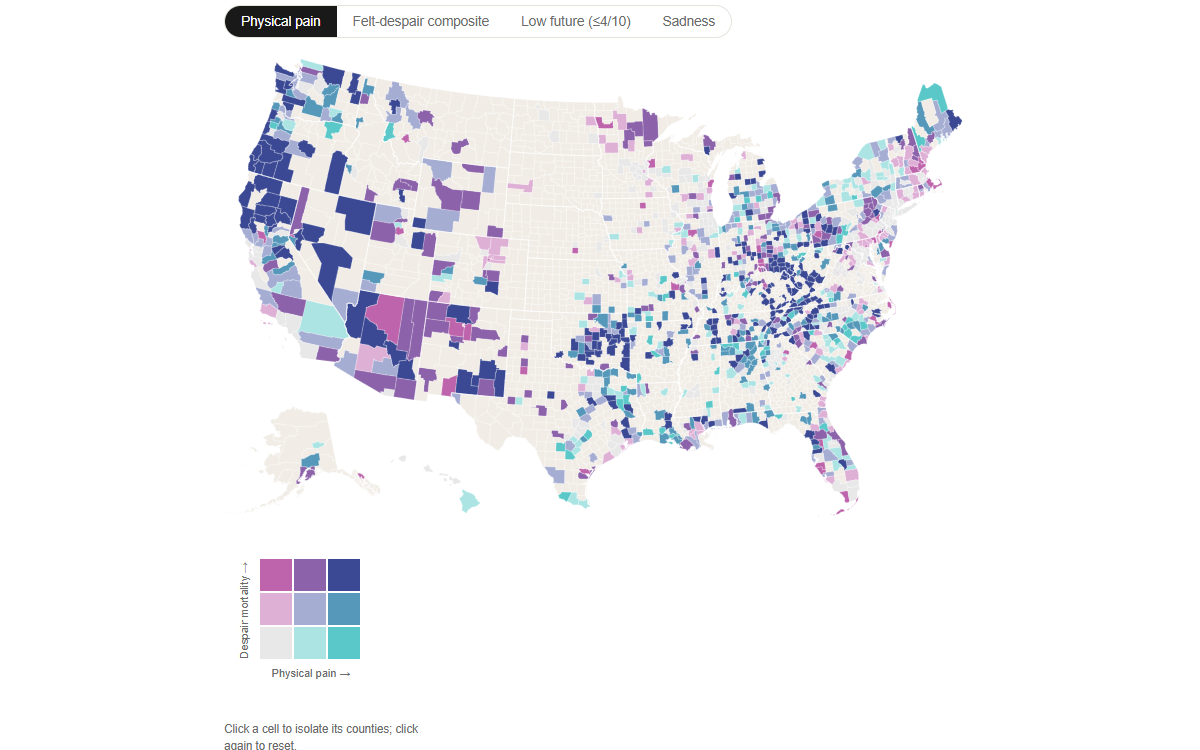
Deaths of Despair vs. Felt Despair
Case and Deaton mapped where Americans die of suicide, drugs, and alcohol. Gallup spent a decade asking Americans how yesterday felt. Lay the feelings over the deaths, and the measure that tracks the mortality map best is not sadness, not worry, not even life satisfaction. It is physical pain — followed closely by the belief that the future holds nothing better.
Health & DespairGeography